Ancient Mayans
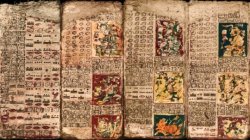 For more than 120 years the Venus Table of the Dresden Codex - an ancient Mayan book containing astronomical data - has been of great interest to scholars around the world. The accuracy of its observations, especially the calculation of a kind of 'leap year' in the Mayan Calendar, was deemed an impressive curiosity used primarily for astrology.
But UC Santa Barbara's Gerardo Aldana, a professor of anthropology and of Chicana and Chicano studies, believes the Venus Table has been misunderstood and vastly underappreciated. In a new journal article, Aldana makes the case that the Venus Table represents a remarkable innovation in mathematics and astronomy - and a distinctly Mayan accomplishment. "That's why I'm calling it 'discovering discovery, ' " he explained, "because it's not just their discovery, it's all the blinders that we have, that we've constructed and put in place that prevent us from seeing that this was their own actual scientific discovery made by Mayan people at a Mayan city."
Multitasking science
Aldana's paper, "Discovering Discovery: Chich'en Itza, the Dresden Codex Venus Table and 10th Century Mayan Astronomical Innovation, " in the Journal of Astronomy in Culture, blends the study of Mayan hieroglyphics (epigraphy), archaeology and astronomy to present a new interpretation of the Venus Table, which tracks the observable phases of the second planet from the Sun. Using this multidisciplinary approach, he said, a new reading of the table demonstrates that the mathematical correction of their "Venus calendar" - a sophisticated innovation - was likely developed at the city of Chich'en Itza during the Terminal Classic period (AD 800-1000). What's more, the calculations may have been done under the patronage of K'ak' U Pakal K'awiil, one of the city's most prominent historical figures.
"This is the part that I find to be most rewarding, that when we get in here, we're looking at the work of an individual Mayan, and we could call him or her a scientist, an astronomer, " Aldana said. "This person, who's witnessing events at this one city during this very specific period of time, created, through their own creativity, this mathematical innovation."

|
Yogi Tea Mayan Cocoa Spice, 16-count (Pack of6) Grocery (Yogi)
|